
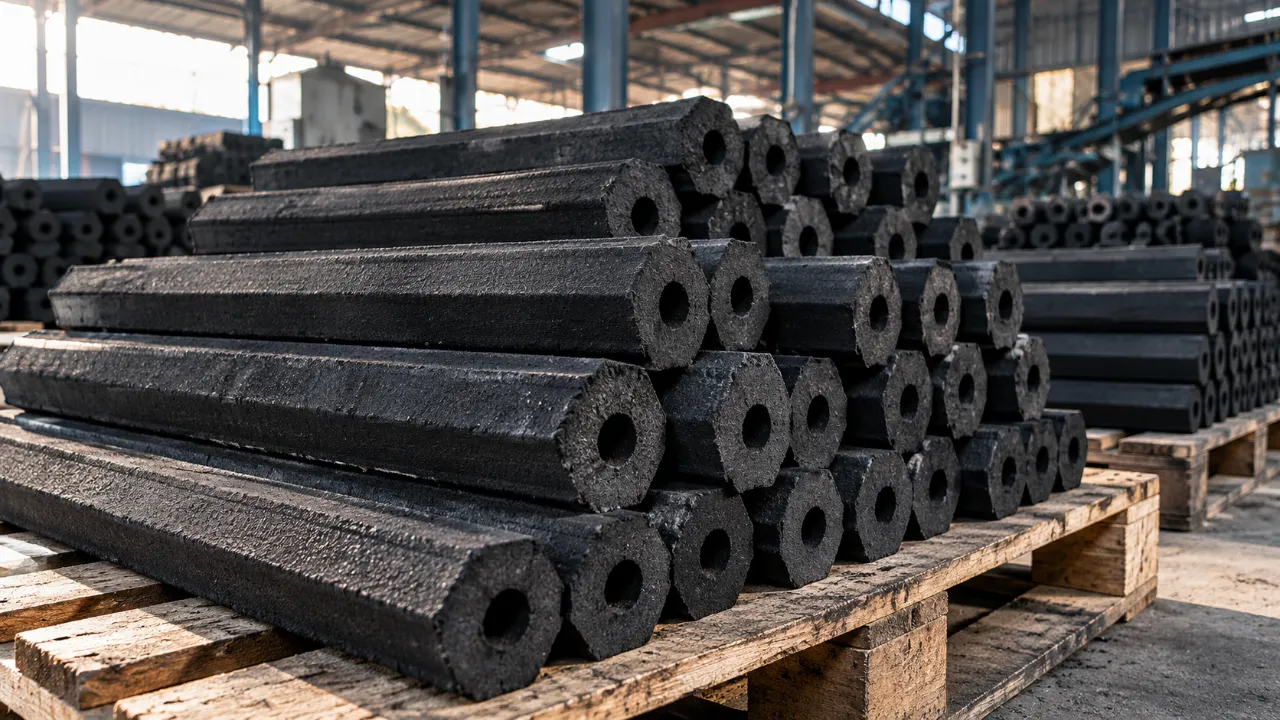
Hexagonal charcoal briquettes have attracted interest among international charcoal buyers because of their distinctive shape, organized appearance, and potential suitability for various fuel markets. For importers, distributors, and wholesale purchasers looking for hexagonal charcoal briquettes from Indonesia, understanding product characteristics and technical requirements is an essential part of making informed sourcing decisions.
Summary: Hexagonal charcoal briquettes are elongated, compressed charcoal products typically featuring a polygonal exterior and a central hollow opening. PT Lamora Sukses Lestari, an Indonesian charcoal manufacturer, presents this product form as part of its manufacturing offering. This guide explains the visible features of hexagonal charcoal briquettes, possible commercial applications, essential quality parameters, product sampling considerations, and practical steps for international buyers requesting quotations from Indonesia.
What Are Hexagonal Charcoal Briquettes?
Hexagonal charcoal briquettes are formed charcoal products characterized by their elongated shape and hexagonal-style cross-section. A central opening typically runs along the length of the briquette, giving the product a distinctive hollow structure.
Unlike natural lump charcoal, which generally has irregular shapes, manufactured briquettes can be produced in defined dimensions and profiles. The final characteristics depend on the raw materials, processing methods, forming equipment, and manufacturing conditions.
Different manufacturers may use different material compositions and production methods. Therefore, a hexagonal shape alone does not establish whether a briquette is made from wood charcoal, sawdust-based material, coconut-derived charcoal, or another carbon-containing feedstock.
International buyers should confirm material composition directly with the manufacturer rather than relying solely on product appearance.
Key Features of Hexagonal Charcoal Briquettes
Hexagonal briquettes offer several physical characteristics that make them recognizable within the broader charcoal market.
1. Distinctive Hexagonal Profile
The external polygonal shape distinguishes hexagonal briquettes from round, pillow-shaped, cube-shaped, and irregular lump charcoal products.
This defined geometry can make product presentation, arrangement, and dimensional inspection more straightforward than with irregularly shaped charcoal.
Nevertheless, manufacturing consistency should be evaluated through actual samples and agreed dimensional tolerances.
2. Hollow Center Design
One of the most noticeable features is the central hole running through the briquette.
Depending on how the charcoal is arranged and burned, this opening can allow air to pass through part of the product. However, combustion performance also depends on material composition, density, moisture content, and operating conditions.
The presence of a hollow center should not automatically be interpreted as proof of faster ignition, longer burning time, or higher heating performance.
3. Elongated Stick Form
Many hexagonal charcoal briquettes are manufactured in a relatively long stick-like format. This can be convenient for stacking and arranging products during storage or packaging.
Buyers should specify the acceptable length range and whether shorter pieces or broken sections are permitted in a shipment.
4. Defined Product Dimensions
Unlike conventional lump charcoal, manufactured charcoal products can be evaluated against specified dimensional requirements.
Common buyer considerations include external diameter or cross-sectional dimensions, hollow opening size, length, and individual piece weight.
The actual dimensions offered by a supplier should be confirmed before a commercial agreement is finalized.
Potential Applications of Hexagonal Charcoal Briquettes
Charcoal briquettes may be considered for different commercial applications, but not every briquette is appropriate for every purpose.
Importers should match the intended application to the verified chemical and physical properties of the product.
Commercial Fuel Distribution
Businesses involved in fuel distribution may evaluate hexagonal briquettes as a product category for resale through established wholesale or retail networks.
Before selecting a product, distributors should consider the expectations of their target market, packaging preferences, applicable regulations, and consistent access to verified product specifications.
Cooking and Barbecue Markets
Certain charcoal briquettes can be used in cooking and barbecue applications, provided their composition, safety characteristics, and combustion behavior are suitable for the intended use.
Buyers serving food-related markets should pay particular attention to raw materials, binder composition where applicable, smoke characteristics, ash behavior, and relevant destination-market safety requirements.
The suitability of PT Lamora Sukses Lestari’s specific hexagonal briquettes for food-related applications should be confirmed rather than assumed from their appearance.
Heating and Other Fuel Applications
Some charcoal products are evaluated for heating or other fuel uses. Performance requirements may differ substantially depending on the intended equipment and operating conditions.
Before purchasing, buyers should identify the desired fuel characteristics and assess whether the available product meets those requirements.
Understanding Charcoal Briquette Quality Specifications
For international procurement, product quality should be described through measurable properties rather than general claims such as “premium quality” or “maximum heat.”
The Food and Agriculture Organization of the United Nations (FAO) identifies several important charcoal characteristics, including moisture content, volatile matter, fixed carbon, and ash content.
Fixed Carbon Content
Fixed carbon is an analytical parameter that represents the carbonaceous portion remaining after moisture and volatile components have been accounted for in a standard proximate analysis.
It is an important consideration for various fuel and industrial applications, although the preferred value depends on the intended use.
Buyers should request a documented result when fixed carbon is part of their purchasing criteria.
Moisture Content
Moisture describes the amount of water present in the charcoal product. Moisture can affect product weight, storage conditions, and the amount of useful heat obtained during combustion.
Moisture requirements should be agreed upon in advance, including the test method and acceptable limits.
Ash Content
Ash is the inorganic residue left after combustion. The acceptable amount may vary between cooking, heating, and other charcoal applications.
Buyers should clarify ash requirements and confirm how analytical results are measured and reported.
Volatile Matter
Volatile matter is another relevant charcoal characteristic. It can influence ignition behavior and combustion properties.
Its relationship with the other quality parameters should be evaluated rather than interpreted in isolation.
Calorific Value
Calorific value describes the energy released during combustion under defined testing conditions.
International buyers comparing products for fuel applications may request laboratory analysis or other reliable technical documentation.
Physical Strength and Breakage
For long hexagonal briquettes, physical durability can be especially important during packing, handling, and international transportation.
Buyers may specify acceptable breakage, fines content, and other physical quality requirements to reduce the risk of receiving excessive damaged material.
Important: The quality parameters discussed here are general industry evaluation criteria. They are not verified performance specifications for PT Lamora Sukses Lestari products.
For further reference, see the FAO resources on charcoal quality and charcoal quality-control methods.
Hexagonal Briquettes vs. Natural Lump Charcoal
International buyers frequently compare manufactured briquettes with natural lump charcoal before selecting the product category that suits their business.
Although both products are marketed as charcoal, they differ in physical form and may differ in material composition and manufacturing methods.
| Characteristic | Hexagonal Briquettes | Natural Lump Charcoal |
|---|---|---|
| Shape | Manufactured geometric profile | Irregular natural pieces |
| Central Opening | Commonly present | Generally absent |
| Dimensions | Can be specified by production requirements | Usually sorted by size ranges |
| Physical Appearance | Defined stick-like form | Varied shapes and sizes |
| Material Composition | Depends on the manufacturer | Depends on the source material |
| Combustion Performance | Must be verified through testing | Must be verified through testing |
Neither category is automatically superior. The better choice depends on the intended application, market requirements, available specifications, and verified product performance.
Hexagonal Charcoal Briquettes Manufacturing in Indonesia
Charcoal briquette manufacturing involves preparing suitable material, processing it under controlled operating conditions, and forming or handling the finished product according to the manufacturing method used.
The exact sequence varies between factories and depends on the raw materials, equipment, and product formulation.
PT Lamora Sukses Lestari has documented charcoal processing facilities, raw material storage areas, manufacturing equipment, and finished hexagonal charcoal products.
These facilities support the company’s manufacturing activities and provide prospective buyers with information about its operational infrastructure.
However, photographs of machinery do not establish production capacity, product certification, or laboratory-tested specifications.
Buyers who require such information should request appropriate confirmation during their sourcing discussions.
Learn more about our company and manufacturing background on the About PT Lamora Sukses Lestari page.
How International Buyers Can Evaluate Product Samples
Product sampling can help importers understand whether a charcoal product is suitable for their purchasing requirements before committing to a larger order.
Review the Physical Appearance
Examine product dimensions, shape, surface condition, and visible differences between individual pieces.
For hexagonal briquettes, pay particular attention to the central opening and the consistency of the exterior profile.
Assess Handling and Breakage
Check the condition of the sample after normal handling. This can provide an initial indication of physical durability, although standardized testing may be required for a reliable assessment.
Request Technical Verification
Where performance specifications are important, request appropriate test results or arrange independent laboratory evaluation.
Buyers and suppliers should agree on sampling methods and the acceptance criteria before finalizing orders.
Confirm Commercial Sample Arrangements
Ask about sample availability, quantity, packaging, shipping charges, and delivery arrangements.
Sample requests can be discussed with PT Lamora Sukses Lestari as part of the initial product inquiry process.
Packaging and Bulk Ordering Considerations
Packaging is an important part of international charcoal purchasing because it affects handling, protection, labeling, and shipment preparation.
Depending on supplier capabilities and commercial agreements, buyers may request different packaging arrangements.
Important details to confirm include:
- Net weight per package.
- Packaging material and bag or carton dimensions.
- Labeling and destination-market requirements.
- Protection against moisture during storage and transportation.
- Palletization and handling requirements.
- Acceptable breakage and fines limits.
- Container loading arrangements.
Specific packaging options and minimum order quantities should be confirmed with the manufacturer. Product presentation alone does not establish the packaging available for export.
Shipping Charcoal Briquettes from Indonesia
Once the product requirements and commercial conditions are agreed upon, buyers need to consider international shipping arrangements.
Important factors include the port of shipment, destination port, freight responsibilities, export documentation, and any cargo acceptance or safety requirements.
PT Lamora Sukses Lestari can discuss export coordination and FOB shipping arrangements through Belawan Port, Indonesia, subject to confirmation of the order and logistics requirements.
Under the International Chamber of Commerce’s Incoterms rules, FOB generally involves delivery of the goods on board a vessel nominated by the buyer at the named port of shipment.
For containerized cargo, buyers should also assess whether the proposed Incoterm is appropriate for the actual handover arrangement. Freight forwarders and logistics professionals can help clarify the responsibilities involved.
For official guidance on international commercial terms, visit the International Chamber of Commerce.
Importers should also verify the applicable shipping classification, packaging, and carrier requirements for the specific charcoal product before dispatch.
Why Consider PT Lamora Sukses Lestari?
Choosing a charcoal supplier involves finding a company whose products, manufacturing arrangements, and commercial approach fit the buyer’s requirements.
PT Lamora Sukses Lestari provides a direct point of contact for inquiries related to hexagonal charcoal briquettes and Indonesian charcoal manufacturing.
Potential buyers can discuss product information, specifications, sample requests, quantities, and export arrangements with the company’s team.
The company also presents supporting services involving manufacturing, product inspection, sampling inquiries, and international shipping coordination.
Explore our charcoal products and manufacturing and export services for more information.
Frequently Asked Questions
What is a hexagonal charcoal briquette?
It is a manufactured charcoal product with an elongated polygonal shape, commonly featuring a hollow opening through the center.
Are hexagonal charcoal briquettes made from sawdust?
Some manufacturers use sawdust-derived materials, while others may use different feedstocks or formulations. Raw material composition should be confirmed with the supplier.
Are hexagonal charcoal briquettes suitable for barbecue use?
They may be suitable for certain cooking applications if their composition, safety characteristics, and combustion performance meet the relevant requirements. Suitability should be verified for the particular product.
How do buyers determine charcoal briquette quality?
Common evaluation parameters include fixed carbon, moisture content, ash content, volatile matter, calorific value, and physical durability. Laboratory testing may be required.
Can international buyers request samples from PT Lamora Sukses Lestari?
Prospective buyers can submit product sample inquiries. Availability, sample costs, and shipping arrangements should be confirmed with the company.
Does PT Lamora Sukses Lestari provide export quotations?
International buyers can contact the company to discuss charcoal product requirements and request export quotation information.
What information should I include in a quotation request?
Provide the product type, intended application, technical specifications, estimated quantity, packaging preferences, destination country, and preferred shipping terms.
Request Hexagonal Charcoal Briquettes from Indonesia
Are you an importer, distributor, or wholesale buyer looking for hexagonal charcoal briquettes from Indonesia?
Contact PT Lamora Sukses Lestari to discuss your product requirements, available specifications, sample inquiries, and international sourcing arrangements.
PT Lamora Sukses Lestari
Indonesian Charcoal Manufacturer
Email: pttoguenergibaru@gmail.com
WhatsApp: +62 813 7555 2888
Request a Hexagonal Charcoal Briquettes Quotation via WhatsApp